
US Civil Affairs (CA) are designated active component and reserve component forces and units organized, trained, and equipped specifically to conduct CA Operations (CAO) and to support Civil-Military Operations (CMO). US Civil Affairs forces conduct missions worldwide in support of their role in the Combatant Commander’s interface to the civil component of the operational environment. The role of CA is to engage and leverage the civil component of the operational environment while enhancing, enabling, or providing governance throughout the spectrum of competition. CA forces are organized, trained, and equipped specifically to plan and execute Civil Affairs Operations (CAO). Across a range of military operations, CA forces conduct CAO to engage and leverage people, organizations, and capabilities to enhance, enable, or provide governance, increase situational understanding, identify and defeat threats within the civil component, and consolidate gains. . Senior-level CA planning and policy representation across the army and DOD agencies promote proper integration of civil considerations into the planning process and early determination of requirements.
2.6.1. US Civil Affairs Fundamentals
Civil Affairs Operations are those planned, coordinated, executed, and assessed to enhance awareness of and manage interaction with the civil component of the operational environment, identify and mitigate underlying causes of instability within civil society, and/or involve the application of functional specialty skills normally the responsibility of civil government. US Army CA executes Civil Affairs Operations through four core competencies: (1) Civil Knowledge Integration, (2) Civil-Military Integration, (3) Civil Network Development and Engagement, and (4) Civil-Military Integration. For core competencies, refer to the diagram.
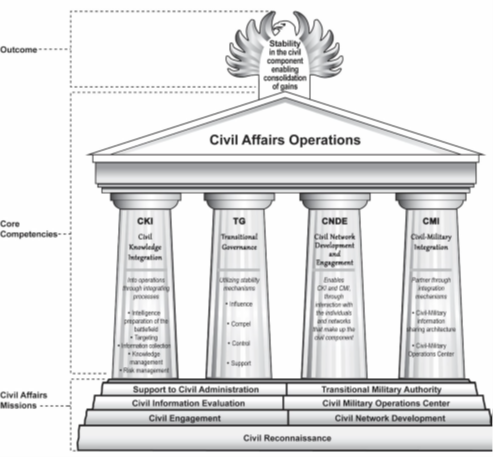
Figure 2.6 – Civil Affairs Operations
Civil Affairs Missions
Civil Affairs formations are trained to conduct missions in Civil Reconnaisance, Civil Engagement, Civil Network Development, Civil Information Evaluation, Establish a Civil Military Operations Center (CMOC), Support to Civil Administration, and Transitional Military Authority.
Civil Affairs products
CA personnel are trained to source and prepare civil information products to inform the planning process and enhance understanding of civil considerations. CA personnel prepare area studies, conduct assessments, conduct civil reconnaissance, and create and maintain running estimates to assist in the planning and updating mission plans across the range of military operations. These products develop and update the understanding of the civil component for the commander’s common operational picture. Through Civil Knowledge Integration, CA personnel develop the understanding of civil considerations relevant to the Warfighting Functions. The information and material contained within these products are critical for the commander’s and staff’s situational understanding and the formation of the commander’s vision for the operational environment, including:
- impacts of the populace on military operations,
- impacts of military operations on the populace,
- development of courses of action,
- development of branches and sequels,
- completion of objectives, goals, and milestones,
- facilitation of the transition of army operations,
- identification and reinforcement efforts to consolidate gains and
- information requirements that drive and focus the civil information collection plan.
Civil Affairs assessments
CA assessments provide a precise means to gather meaningful and significant information. CA soldiers perform three basic types of assessments – the initial assessment, the deliberate assessment, and the survey. Gathering information should not be a haphazard process. Each type of assessment is based on the information and analysis of the previous type. In addition, each type of assessment in the progression becomes more focused, specific, and detailed with an ultimate goal of identifying civil vulnerabilities that pose a threat to the successful and timely completion of the mission. This task must have a well-formed, practical plan as with all military missions.
2.6.2. US Civil Affairs and NATO CIMIC
US Civil Affairs and NATO CIMIC both address the civil-military interface and the civil component of the operational environment as a military capability. CA and CIMIC forces perform a number of common tasks, including:
- Open source information collection and analysis
- Civil Reconnaissance
- Civil Engagements
- Reporting
NATO CIMIC and US CA have a long history of cooperation and mutual support. CIMIC and US CA both serve as the eyes and ears of thesupported commanderto understand the the civil factors of the operating environment. Both CA and CIMIC share common activities:
- Assessing and understanding civil dynamics and the operational environment
- Interacting with civilian stakeholders
- Advising and facilitating military commanders and decision-making
US CA and NATO CIMIC comparison
| US CIVIL AFFAIRS | NATO CIMIC |
| Civil reconnaissance | Civil reconnaissance |
| Civil engagement | Civil engagement |
| Civil information evaluation | Civil factor analysis |
| Civil-military operations centre | CIMIC centre |
| Military staff support | Military staff support |
| Support to civil administration | CIMIC functional specialists |
During Counterinsurgency and Crisis Response operations, CIMIC and CA mutually focused winning and maintaining legitimacy within the civilian population to contribute to promote stability and influence successful mission outcomes. In a threat landscape dominated by peer and near-peer threats, CIMIC and CA are focus on analysing and assessing the influence of the civil environment on military operations and the civil considerations that influence mission success. In each case, CIMIC and CA are military capabilities responsive to military commanders. CIMIC and CA make crucial contributions to battlespace management and the civil considerations influential to the supported commanders’ area of responsibility, to the Preparation of the Operational Environment,, and the Common Operating Picture (COP). Both perform Civil Reconnaissance and Civil Engagements. At higher echelons, S/G/J9 personnel attend and contribute to key boards and working groups within the headquarters’ battle rhythm.