
Definition of Resilience
Resilience is commonly understood as the underlying ability to withstand or overcome (abrupt) crises and shocks and thus maintain essential functions. Resilience is an essential basis for credible deterrence and defence[1]. NATO considers strong societies as the first line of defence, and as a necessity for a successful military operation. As today’s societies are highly complex systems based on the functioning of critical infrastructures, societal resilience, as a cross-cutting aspect of all elements of resilience, became the new focus of NATO’s resilience agenda.
Currently, within NATO, there are two generally accepted definitions of resilience: according to the AJP 3.19, resilience is ““[…] the ability of an entity to continue to perform specified functions during and after an attack or an incident.” (AJP 3.19/1.12), while the second defines it as “The ability of a functional unit to continue to perform a required function in the presence of faults or errors”. Both definitions provide a broad, overarching description, yet there remains a need for a more system-oriented definition.
The following figure reflects one of the key messages of NATO’s 2022 Strategic Concept regarding the function of resilience systems.. Resilience in this context is an adaptive process in which the system’s performance is defined by absorbing strategic shocks with minimal impact (Capacity Gap). At the same time, essential functions of the system are maintained at a sufficient level to restore functionality in a reasonable time (t1) and at a reasonable cost. While preparation for strategic shocks is integral, these shocks are usually unpredictable and unavoidable. Therefore, a resilient system focuses specifically on managing the consequences of a shock and isolating the event from the function of the overall system. In the final phase, the recovery phase, the system focuses on increasing its capacity to withstand similar strategic shocks in the future. A key element of this phase is adaptation: by integrating the lessons learned and newly acquired knowledge from managing the crisis back into the system, its effectiveness and resilience against future shocks are improved, thereby reducing their potential impact. In several speeches, articles and lectures, the final phase described above is strikingly formulated as the “bounce back” effect. [2] This term is taken from the general resilience literature.[3]
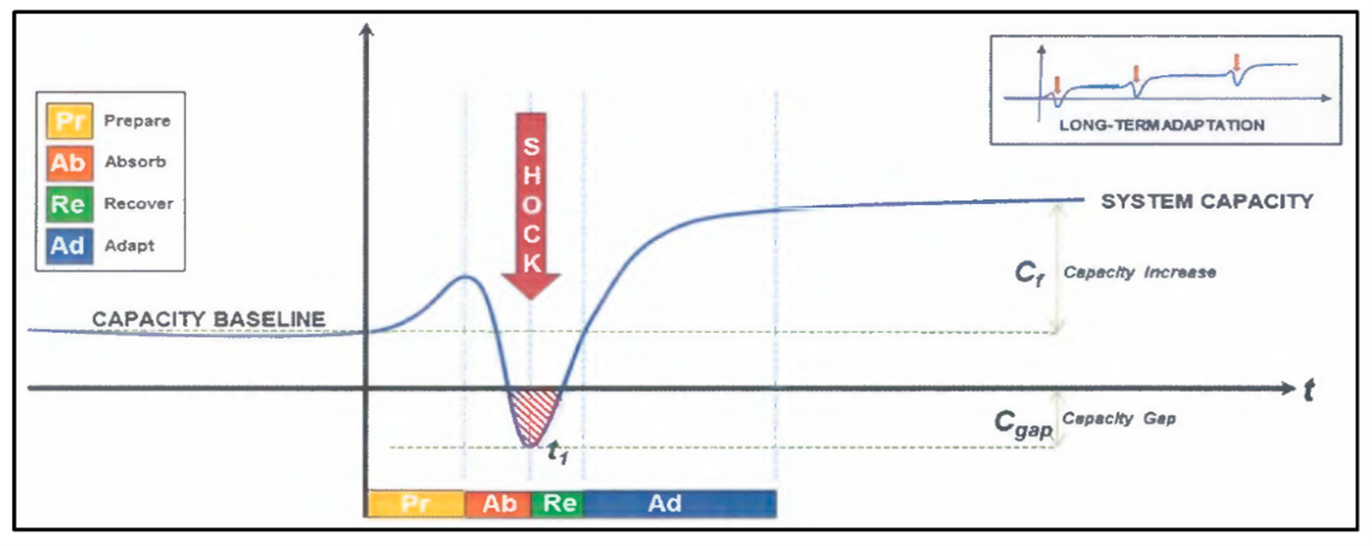
Therefore, the working definition is: “Resilience refers to the ability of a society to withstand strategic shocks and to recover easily and quickly from them. Resilience combines civil and societal emergency preparedness as well as military capabilities”.
[1] Allied Command Operations, 2019, p. 7
[2] Roepke, Thankey, 2019, pp. 2-8.; Stoltenberg, 2020, p. 3; CCOE, 2018, p. 5
[3] Smith et al., 2010, p. 194
[1] https://www.nato.int/en/about-us/official-texts-and-resources/official-texts/2021/06/14/strengthened-resilience-commitment
7.1.1. The Layered Resilience Concept
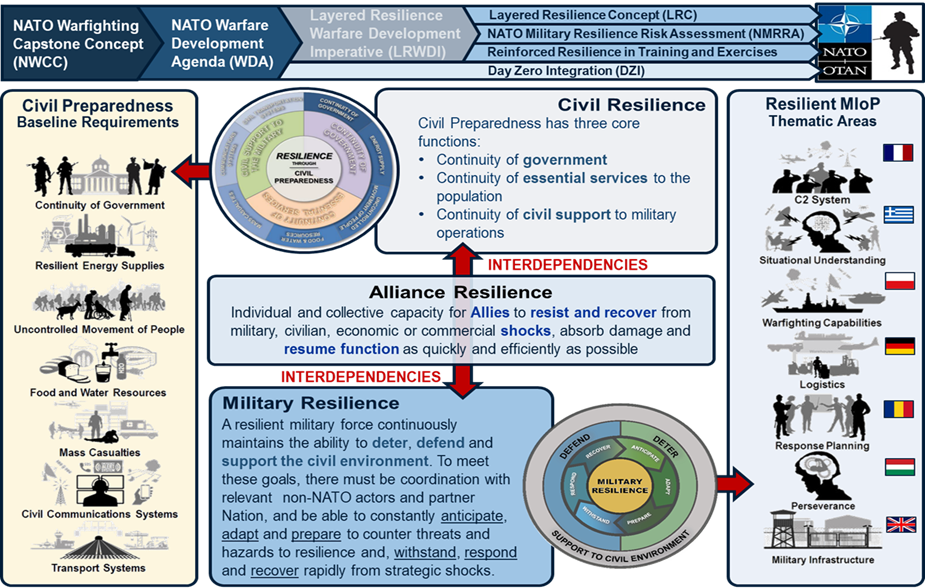
The Layered Resilience Concept’s (LRC) central aim is to contribute to the Alliance’s maturing perspective on resilience by filling in the gap of understanding on military resilience: providing descriptions of both layered resilience and military resilience; offering a framework for decision- makers to factor in resilience when developing their Military Instrument of Power (MIoP); and providing a military lens for Alliance Resilience while highlighting the interdependencies between the military layer and all other Alliance resilience layers.
7.1.2. Layers of resilience
- To generate a holistic understanding of the whole-of-government and whole-of-society nature of Resilience, the LRC breaks down Resilience into three layers: Societal, Civil, and Military.
The Societal layer refers to the citizens and the wider civil society of Allied nations. Its resilience relies mainly on the population’s level of preparedness, their awareness of information-related threats, and their overall support for national defence efforts. Within this layer, the focus is on the capabilities of civil society and how the population contributes to national resilience.
The Civil layer includes both public and private sector actors and is centred on ensuring the continuity of government, the provision of essential services, and civil support to military activities. From a NATO point of view, this is the most mature layer, largely due to the work carried out under the Resilience through Civil Preparedness strand. This layer assesses the capabilities and national inputs to resilience coming from public and private stakeholders. It also incorporates the seven baseline requirements for national resilience, agreed at the 2016 Warsaw Summit, which serve as benchmarks for Allies to evaluate their level of preparedness.
The final layer is the Military layer, which focuses on building military resilience through adequate military capacity and capability, ensuring that Allies can continue to deter and defend. When requested, they provide support to the civil environment. This layer considers the military’s capabilities and its national contributions to overall resilience.
Alliance resilience is built on the interdependent and mutually reinforcing relationship between the Civil, Military, and Societal layers. This interdependency underscores the need for continuous coordination to maximise strengths and reduce vulnerabilities. Military resilience within the MIoP is guided by the Military Resilience Framework, where deterrence, defence, and support to the civil environment are enabled through key military activities. A resilient MIoP must anticipate, adapt, and prepare for threats capable of creating strategic shocks or prolonged crises, while also being able to withstand, respond to, and recover from adversarial actions. When required, it must additionally support the civil environment, coordinating with non-military actors to contribute to broader Alliance objectives and a comprehensive approach to operations.