
Introduction
The term Cross-Cutting Topics (CCT) refers to a range of different topics that could affect the mission in a number of ways, but which fall outside of the military’s primary responsibilities. Different military disciplines, branches, and command levels may have to consider and address a variety of CCTs. As described in the NATO AJP 01 (Ed F, vs.1), the current CCTs are comprised of Protection of Civilians (PoC), Children and Armed Conflict (CAAC), Cultural Property Protection (CPP), Women, Peace and Security (WPS), Conflict-Related Sexual Violence (CRSV), Sexual Exploitation and Abuse (SEA), Combating Trafficking in Human Beings (CTHB) and Building Integrity (BI).
Human Security is a development topic within NATO. According to NATO’s current Human Security Guiding Principles, the focus is on areas where the Alliance can be most effective: PoC, CAAC, CPP, CRSV, and CTHB.[1]
Although the planning and execution of activities related to the CCTs are the responsibility of the commander and all subordinate branches and units, CIMIC (J9) has a strong link with CCTs. Integrating Civil Factors is one of CIMIC’s core activities. During all phases of the Comprehensive Operational Planning process, CIMIC representatives should ensure that these aspects are part of the planning, plans, and execution. Information exchange through Civil Military Interaction, CIMIC’s other core function, will be done with HNs, IOs, GOs and NGOs. By collecting all information related to the CCTs, CIMIC branches and units can build a picture of the civil environment in support of the decisions of the commander.
The Cross-Cutting Topics
In this chapter, we examine each cross-cutting topic. We will explain them in general terms and provide a vignette of how they are used in operational practice.
PoC: Protection of Civilians
PoC is an overarching principle guiding both military personnel and aid workers. It closely aligns with the Responsibility to Protect. The most effective way to protect civilians is to bring an end to violent conflicts, build trust and confidence among parties in peaceful solutions, and advance peace processes and national reconciliation. PoC focuses on three Lenses: 1: Mitigate Harm (MH)[2], 2: Facilitate Access to Basic Needs, 3: Contribute to a Safe and Secure environment.
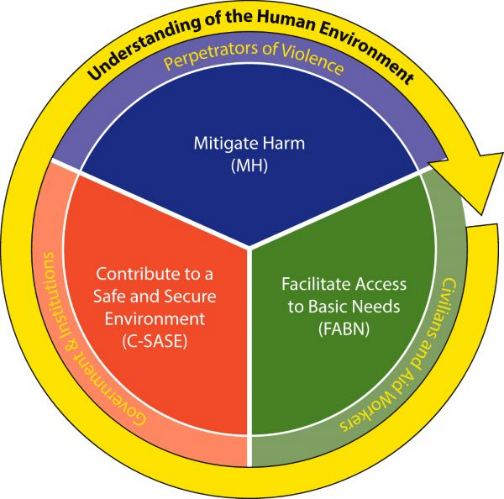
All efforts taken to avoid, minimize and mitigate the negative effects on persons, objects and services by own and adversary actions and to protect civilians from conflict-related physical violence.
Although MH is the lens through which the military can make a difference by its own actions, CIMIC also observes, analyses, and reports on the two other elements of PoC (“Facilitate access to Basic needs” and “contribute to a safe and secure environment”) to support understanding of the relevant Civil Factors.
To operationalise protection of civilians, operators should take their own behaviour into account. All activities that could put civilians in danger should be considered. That could include a threat as a secondary effect of our own activities on our own territory, a threat from adversaries against civilians and critical infrastructure.
Vignette: Platoon-leader Jones is about to establish her command post in the parking lot of a water treatment plant. Although this location provides all the necessities for her platoon, it also poses a risk of being targeted and causing collateral damage to the vital civilian infrastructure, the plant. She should reconsider the location to reduce harm to civilians.
CAAC: Children and Armed Conflict
Protection of children affected by armed conflict.
Children are involved in and affected by conflicts in different ways.
They are always victims and need to be protected, even when they may be perpetrators of crimes.
In order to advance the goal of protecting children during armed conflict and ending the impunity of perpetrators, the UN Security Council Resolution (UNSCR) #1612 identifies six categories of grave violations – known as the six grave violations, which form the basis of evidence-gathering and monitoring. These are: killing and maiming of children; abduction of children; forced association of children by armed forces or armed groups; sexual violence; Attacks on schools and hospitals and staff; denial of humanitarian access to children.
Killing and maiming of children; Recruitment or use of children as soldiers; Sexual violence against children; Abduction of children; Attacks against schools or hospitals; Denial of humanitarian access for children.
A child means “every human being below the age of 18 years unless under the law applicable to the child, majority is attained earlier”.
In many conflicts, children forced into service by armed groups directly take part in combat. However, their role is often not limited to fighting. Many children are also used in support functions that also involve great risk and hardship. Moreover, the use of children in acts of terrorism, including as suicide bombers, has emerged.
Understanding who is affected and how they are affected can lead to better addressing the specific needs of children. Therefore, sound analysis of children’s involvement, their needs, and rights, as well as information and knowledge exchange with other units and non-military actors, is indispensable for a comprehensive understanding of those Civil Factors.
To operationalise Children and Armed Conflict, operators must ensure that CAAC-related items are included in the planning, plans and execution of the mission. Meanwhile operators should diligently observe violations of the six grave violations. If observed, they should report them through appropriate channels and present them to current non-military actors in the JOA, such as local authorities, UNICEF, ICRC, or War Child.
Vignette: During a conversation between a CIMIC staff member and a teacher at the city’s secondary school, it emerged that there had recently been a high dropout rate among young girls. He also mentioned rumours circulating that a criminal organisation was recruiting these young girls for prostitution. This CIMIC staff member filed a report and discussed the incident with the local police commander and UNICEF representative. This case constitutes one of the six grave violations.
CPP: Cultural Property Protection
To protect and respect cultural property by own actions and to avoid, as much as possible, the risks to cultural property caused by others.
Based upon the Hague conventions of 1954 and its additional protocols, NATO embraced the protection of Cultural Property during armed conflict
Cultural property (CP) is an integral part of a people’s identity. It can reflect their heritage, their values, or their religion. At the same time, it is fragile and, if damaged, might be irreparable. Therefore, it requires constant and careful consideration and protection during a mission. Protection of Cultural Property should also pay attention to intangible cultural heritage, such as performing arts, rituals, festive events, etc. Intangible cultural heritage is important in maintaining cultural diversity in the face of growing globalisation. An understanding of the intangible cultural heritage of different communities helps with intercultural dialogue and encourages mutual respect for other ways of life.
CPP refers to all measures to protect cultural property against damage, destruction, theft, embezzlement, or other loss. In the context of immovable cultural property, the term “monument protection” is used. Bound by international law and its positive contribution to a safe and secure environment, the military, and especially CIMIC, must take both a support position and a proactive stand regarding CPP.
Illicit trade in all kinds of art can be a source of income for (illegal) armed actors and, as such, is directly connected to the duration of an armed conflict.
CIMIC analysis and assessment of CP factors are integral aspects of the understanding of the operating environment and, therefore, indispensable for the protection of CP and, eventually, mission success.[3]
To operationalise CPP, operators should begin preparations in Peacetime. Identification and listing of CP in the JOA are important for understanding the civil environment. Preferably, this should be in cooperation with local museums and authorities. During the planning of kinetic operations the CIMIC/J9 representative must monitor and advise the commander to ensure that CP remains as safe as possible from damage or destruction.
Vignette: Aircraft next to the City of Ur/ Iraq 1991
During the First Gulf War, the Iraqi forces of Saddam Hussein placed two military aircraft next to the heritage site of Ur. Although aircraft are a legitimate military target, coalition commanders decided not to attack them in this case. As no runway was nearby, the aircraft were effectively put out of action. Therefore, the damage to the ancient temple would be disproportionate to the value of the destruction of the aircraft.
Source: UNESCO Military Manual (2016).
WPS: Women, Peace and Security
Promotes a gender perspective, the protection of women and their equal and meaningful participation in peace processes, peacebuilding and security.
The WPS agenda of today is the product of more than a century of international women’s peace activism. The agenda, which integrates gender perspectives and gender mainstreaming, started with UN Security Council Resolution (UNSCR) 1325 in 2000, followed by several related Resolutions.[4]
The foundation of the WPS agenda builds on two separate but equal concepts: protection from sexual violence and increasing participation of women in all areas (political, social, military and economic). If integrated, implemented and interconnected, these concepts provide the baseline for gender equality.
Special attention to the role women play in society might be an igniter for the peace process and provide additional essential information.
The latest NATO Policy on WPS, adopted in 2024, continues to make gender-responsive leadership and accountability cornerstones of implementation. It requires commanders and senior staff to integrate gender perspectives into operational planning and to link leadership evaluation with ethical and inclusive behaviour. The policy also addresses emerging challenges, such as Technology-Facilitated Gender-Based Violence (TFGBV). Online harassment, sexualised disinformation, and cyber manipulation pose threats to both personnel and civilians, weakening morale, trust, and collective well-being. By addressing these risks, the 2024 WPS policy ensures that inclusion and accountability extend into the digital domain, keeping WPS relevant to modern security challenges.
To operationalise WPS, operators must ensure that WPS-related items are included in the planning, plans and execution of the mission. Observe the roles of women in society, cases of sexual violence in the JOA, and assess gender-based differences in the community. Identify and Liaise with WPS-related non-military actors in the JOA. Report cases of sexual violence with appropriate authorities. Understand the demography in the JOA.
Vignette: During the mission, it emerged that the enemy was posting doctored, sexually suggestive videos of NATO’s female military leaders, intended to portray these officers, the mission, and NATO in a negative light. This form of technology-facilitated gender-based violence is intolerable, punishable, and reprehensible. The units involved are working together with non-military authorities to stop this form of sexual violence and to launch a campaign promoting the quality of our female leaders and the value of gender balance.
CRSV: Conflict-Related Sexual Violence
CRSV is frequently, deliberately and strategically used to target civilians.
CRSV is defined by NATO as rape, sexual slavery, forced prostitution, forced pregnancy, forced abortion, forced sterilisation, forced marriage, and any other form of sexual violence of comparable severity perpetrated against women, men, girls, or boys that is directly or indirectly linked to a conflict.[5]
In conflict and post-conflict contexts, sexual violence is employed as a weapon of war, torture, terror, and political repression. Certain groups are particularly vulnerable to CRSV, including internally displaced persons (IDPs), widows, migrants, sexual and gender minorities (LGBTQI+ individuals), homosexuals, female-headed households, detainees (including prisoners of war), persons with disabilities, and specific ethnic and minority groups. While CRSV is often discussed in relation to civilians, it can also target military personnel, including POWs, impacting morale, cohesion, and operational effectiveness.
CRSV is not merely a gross violation of human rights but also a significant security threat. Wartime rape causes displacement, undermines governance, and destabilises communities, hampering peace negotiations, preventing post-conflict reconciliation, and endangering long-term stability.
CIMIC could enhance further data collection and awareness-raising on the links between gender inequalities, levels of violence against women, men, boys, and girls, and the potential for violent conflict, including CRSV. This may impact both civilians and military personnel and aims to better inform protection, prevention, and operational planning.
To operationalise CRSV, operators must ensure that CRSV-related items are included in the planning, plans and execution of the mission. Identify and liaise with CRSV-related non-military actors (Host Nation, UN Women, UNICEF, UNFPA, UNHCR, etc.) in the JOA. Understand links between conflict and Sexual violence, protection risks, gender dynamics and social attitudes. Collect sex-disaggregated data. Report violations of IH and LOAC, potential war crimes, genocide, crimes against humanity.
Vignette: During a routine CIMIC key leader engagement (KLE) with local community representatives in an IDP camp, a female community leader privately informs the CIMIC team that several women in the camp were raped at night. The alleged perpetrators are members of a local partner security force that NATO is mentoring. Victims are afraid to report the crimes due to fear of retaliation and lack of trust in local police. She asks for protection but insists the information remain confidential.
CIMIC must immediately report via: Chain of Command, Gender Advisor (GENAD), Legal Advisor (LEGAD) and Human Rights Advisor (if present)
SEA: Sexual Exploitation and Abuse
Focuses on own behaviour – NATO prohibited its own personnel from engaging in or facilitating any form of SEA.
Sexual harassment and exploitation have been longstanding challenges for militaries worldwide, including NATO. In recent years, NATO has made a concerted effort to reduce gender disparities and tackle/ prevent from sexual exploitation and harassment.
Sexual Exploitation is defined by NATO as any actual or attempted abuse of a position of vulnerability, differential power or trust, for sexual purposes, including, but not limited to, profiting monetarily, socially or politically from the sexual exploitation of another.
Sexual Abuse is any actual or threatened physical intrusion of a sexual nature, whether by force or under unequal or coercive conditions.
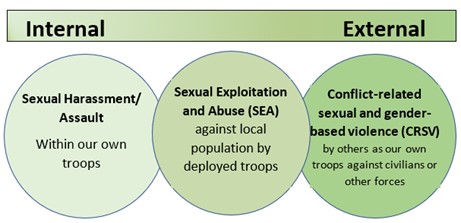
The SEA policy clearly sets out NATO’s zero-tolerance approach, defines unacceptable behaviours, measures for prevention, and how allies will work collectively to ensure accountability. Member states are responsible for all investigations of sexual misconduct complaints and for follow-up actions, including any penalties, with NATO itself providing only preliminary investigations.
The policy emphasises that sexual harassment and exploitation are against the inherent principles and values of NATO and put the organisation and its missions at risk. Thus, the policy requires that potential risks be identified, assessed, and addressed during mission planning, and that all reasonable efforts be made to mitigate the danger and, therefore, make it subject to CIMIC as well.
To operationalise SEA, operators must ensure that SEA-related items are included in the planning, plans and execution of the mission. Report cases of Sexual Exploitation or Abuse to the commander. Observe the behaviour of own forces. Identify the need for training and liaise with leadership.
CTHB: Combating Trafficking in Human Beings
All efforts taken to prevent, mitigate, counter and respond to trafficking in human beings.
Trafficking in human beings means the recruitment, transportation, transfer, harbouring, or receipt of people by force, fraud, or deception, with the aim of exploiting them for profit.[6]
Human trafficking is not the same as people smuggling. Smugglers bring migrants across borders for payment and with the migrants’ consent. In practice, the distinction between victims of human trafficking and smuggled individuals is often difficult to make. Despite the initial voluntary nature of the trafficked, this often leads to slavery. To repay the costs of trafficking to their smugglers, the trafficked persons are usually forced into slavery or servitude. Similarly, many victims of human trafficking can be refugees, and vice versa.
Human trafficking has far-reaching consequences for a person’s safety and dignity. Fragile states, forced or irregular migration, poverty, discrimination, and a lack of rule of law are just some of the factors that act as a fertile breeding ground for human trafficking. However, human trafficking is also a source of financing for armed conflicts and violent extremism, which in turn can increase conflict and fragility.
Human trafficking can also negatively impact a mission’s credibility and legitimacy, the integrity and safety of soldiers, the achievement of long-term stability, peace, and overall mission success. Therefore, NATO must consider the various aspects of CTHB in the planning and execution of its missions, including the efforts and commitments of other international organisations to prevent and combat it.
A sound, concerted analysis and assessment of CTHB by CIMIC will contribute to a comprehensive understanding of the civil environment and thus support the prevention and combating of it. Moreover, it may prevent the accidental involvement or facilitation of NATO members in human trafficking.
To operationalise CTHB, operators must ensure that CTHB-related items are included in the planning, plans and execution of the mission. Create a map of agencies and organisations that can respond in cases of human trafficking. Liaise with local authorities and non-military actors to identify and understand the presence of human trafficking in the JOA. Report observations of violations of International Humanitarian Law (IHL) or Law of Armed Conflict (LOAC) to the appropriate authorities.
Vignette: During a CIMIC engagement with a mayor in a liberated town, the mayor reports that civilians (mainly foreign seasonal workers and displaced persons) are being rounded up in nearby villages. He claims that they are transported toward the frontline and forced to dig anti-tank trenches, load ammunition, and repair damaged defensive positions. Some are placed near military assets to deter NATO strikes. Families are threatened if they refuse.
Satellite imagery later confirms increased civilian presence near enemy logistics hubs.
BI: Building Integrity
Promote good governance and implement the principles of integrity, transparency and accountability.
BI is a measure to fight corruption without reducing the efficiency of the security apparatus. It focuses on motivation rather than punishment. The NATO BI programme provides practical tools to reduce the risk of corruption in the defence and security sectors. It promotes good practices, processes and methodologies and provides countries with tailored support to make defence and security institutions more effective and efficient.
Corruption in the joint operation area is not only a risk for the mission personnel but also undermines all stabilisation efforts due to its strong link to terrorism, criminal organisations and armed opposition groups. Corruption provides resources (e.g. financial and human) for these groups and affects the efficiency of local security forces and governmental institutions. Fighting corruption helps to establish a safe and secure environment. Moreover, supporting a BI programme could increase public trust in the mission through higher legitimacy. This means that the local population will be more likely to accept and support the mission. These aspects will contribute to force security and more sustainable mission results. Corruption is a major source of social unrest, fuels regional conflict and acts as a key source of instability. There is a clear correlation between corruption, violence and instability. The most corrupt countries in the world often are the scene of insurgencies, extremist activity, or other threats to international security.
BI requires analysis capacities and progress to be assessed. Most of the BI-related factors are situated outside the military realm and become subject to CIMIC. Therefore, CIMIC supports the inclusion of integrity concerns, which might be particularly relevant when interacting with the civil environment and have to be considered during assessment.[7]
Vignette: A CIMIC team receives complaints from local business owners and municipal officials that one contractor supplying fuel to NATO is owned by a relative of a local defence official. Prices are inflated 40% above market value. Fuel deliveries are irregular. There are rumours that part of the fuel is diverted and sold on the black market. The contractor operates near critical military infrastructure.
Human Security
Human Security has been around in the UN context since 1994, but mainly in a development context. It began as an effort to move away from the dominant “national security” approach of competing states and geopolitical blocs and to present a framework for understanding what security might mean for individuals. It aimed to promote well-being as much as provide protection by reshaping and redirecting security practices and resources. It is based on the idea that humans should have freedom from fear, freedom from want and freedom to live in dignity.
Human Security places the human being at the centre, considering that the primary foundation of peace and security rests on satisfying the basic needs of all persons, enabling them to fully exercise their social, cultural, political and economic rights, and being governed by legitimate authorities. Accordingly, it includes economic, nutritional, health, environmental, personal, community and political dimensions.
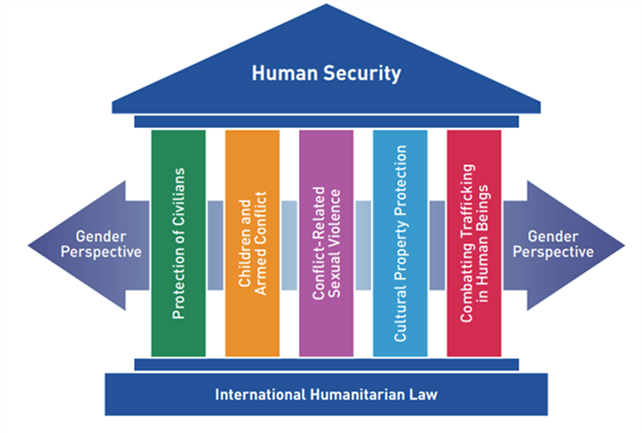
For NATO, the term human security refers to risks and threats to populations where NATO has operations, missions or activities and how to mitigate and respond to them.[1] Human Security stems from NATO’s PoCs concept and the idea that everything we do needs to be population-centric. It means that NATO takes a proactive approach to protection and that the affected people have to be at the heart of all that we do. NATO recognises the importance of reducing the impact of its actions on civilians in conflict zones and elsewhere where it is conducting activities.
In 2022, NATO adopted a framing document outlining its approach to human security, bringing together the CCTs: PoCs, CAAC, CRSV, CPP and CRSV, as well as an overarching gender perspective.
Fieldworker: CCT and understanding the civil environment
Field workers have an important role in building an understanding of the Civil Factors of the Operating Environment. The main role is collecting information from the local population and relevant military and non-military partners. Focusing on CCTs will provide you with a wide range of topics necessary for creating an understanding of the operating environment. The CCTs explicitly mentioned in the mandate of the exercise or in the orders should be given extra attention. Reporting forms for this purpose may be own, nationally developed, or the forms available in the CIMIC Handbook.
To build an understanding of the Civil Factors, PMESII/ASCOPE should be used. Tactical units may also consider creating a soldier card for CCT-related observations to enable more structured mapping of environment-specific and mission-related aspects.
The reporting of observations by the field worker serves three important purposes. Firstly, the observations supplement and strengthen the Comprehensive Understanding of the Operating Environment (CUOE). Secondly, the observations can be used to inform HNs, IOs, NGOs, and other humanitarian players in the mission area about CCT-related aspects that require attention. Finally, the reports of the observations may serve as battlefield evidence for possible future prosecutions under IHL, international criminal law, or domestic law.
A field worker does not play a direct role in the unit’s planning. However, they can also participate in the development of a Cultural Property List, Critical National Infrastructure List, and Partners/Contacts (IO/ GO/ NGO) list. To understand the mission’s tasks and objectives, the fieldworker should be familiar with the Ops order and/or Joint Coordination Order (JCO) as well as additional FRAGOs. This knowledge includes not only the CCT-related assignments but also the unit’s general mission. The main Annex for CIMIC-related tasks and information is Annex W.
Background documents: See the overview under the Staff Workers Chapter.
Staff worker: CCT in plan development and execution
In general, J9 is responsible for ensuring that CCTs, although a whole-HQ responsibility, are duly considered throughout the planning process. This includes identifying and assessing all possible impacts the emerging crisis, its actors, as the HQ’s own operations may have on CCTs.
Strategic Plan Development: J9 staff must facilitate the consideration of CCTs in all stages and products of planning, ensuring that CCTs are covered by all OAs and OEs. If required, dedicated Annexes for CCTs might be developed on an exception basis.
Operations Plan Development (Phase 4A): The focus should be on ensuring CCT requirements are considered in operational actions and covered by the achievement of defined operational effects. If additional information is required, the JOPG should evaluate the by the CIMIC Staff developed Annexes/appendices. The Staff worker is participating in the development of Annexe W and additional appendices focusing on CCT-related content.
Execution (Phase 5): Staff continue developing the Understanding of the Civil environment. The Staff worker participates in relevant Working Groups and boards (e.g., Joint Targeting Coordination Board, Joint Defended Assets Working Group, Force Protection Working Group, and others, as required), with special attention to information relevant to the CCTs. If required, the Staff worker will participate in the Crisis Action Team during a crisis and time-sensitive action.
For details about planning, see Chapter 5 of this handbook
Relevant documents
PoC
- PO(2016) 0407 NATO Policy for POC dated 9 July 2016
- PO(2017) 0055 Action plan for the implementation of the NATO policy for the protection of civilians dated 6 Feb 2017
- MC 0668 Concept for the Protection of Civilians dated 25 April 2018
- Bl-SC Dir 086-006: Implementing protection of Civilians in NATO operations, missions and activities dated 14 Sept 2022
- PoC Handbook dated 2019
CAAC
- NATO Policy on Children and Armed Conflict dated 12 July 2023
- PO (2015) 0165 Final Approval of prot. CAAC Way Forward dated 27 May 2015
- MCM-0104-2015 action plan
- MCM-0016-2012, Children and Armed Conflict (CAAC), dated 10 July 2012
- BI-SC Dir 086-004 Children And Armed Conflict dated 10 June 2016
CPP
- BI-SC Dir 086-005, Implementing Cultural Property Protection in NATO Operations and Missions dated 01 April 2019
- N.b. Own policy for CPP is expected in mid-2025. Until then the PoC policy, Action plan and Concept are the placeholders.
WPS
- NATO Policy on Women, Peace and Security 2024 dated 11 July 2024
- PO(2021) 0336 NATO/EAPC Action plan for the implementation of the NATO/EAPC Policy on Women, Peace and Security 2021 – 2025 dated 21 Oct 2021
- BI-SC DIR 040-001(Rev.3), Integrating Gender Perspective into the NATO Command Structure dated 20 Oct 2021
CRSV
- PO(2021) 0190 NATO Policy on Preventing and Responding to CRSV dated 31 May 2021
- MCM 0009-2015, Military guidelines on the prevention of, and response to conflict-related sexual and gender-based violence
- BI-SC DIR 040-001 (Rev.3), Integrating Gender Perspective into NATO Command Structure dated 20 Oct 2021
CTHB
- NATO Policy on Combatting Trafficking in Human Beings dated 12 July 2023
SEA
- PO(2019) 0459(INV) NATO Policy on Preventing and Responding to Sexual Exploitation and Abuse dated 20 November 2019
BI
- PO(2016) 0310 NATO Building Integrity Policy dated 19 May 2016
- IMSM-0122-2021 NATO Building Integrity action plan for 2021 – 2025 dated 25 May 2021
- PO(2021) 0050 Action plan 2021 – 2025
- MC 0697 Mil Concept for BI in operations dated 12 Feb 2021
- ACO directive 086-005 Implementing BI in Operations dated 01 Feb 2019
[1] Figure 6.1 displays the CCTs under the human security umbrella as yellow hexagons.
[2] Mitigate Harm is the military’s primary focus. It is to avoid collateral damage to civilians by own actions, avoid urban battles, improve targeting and also try to stop the adversary from committing hostile actions against civilians.
[3] E. Pandolfi, et al., (2020). ‘Safeguarding Cultural Property. Creating a NATO Information and Knowledge Management System for Cultural Property’ NATO NEDP, pp. 21, 29 and 34.
[4]The Security Council has adopted 10 resolutions on Women, Peace and Security (WPS): Security Council Resolutions 1325 (2000), 1820 (2008), 1888 (2008), 1889 (2009), 1960 (2010), 2106 (2013), 2122 (2013), 2242 (2015), 2467 (2019), and 2493 (2019).
[5] NATO Policy on Preventing and Responding to CRSV (2021)
[6] Guidelines for NATO staff on preventing the promotion and facilitation of trafficking in human beings (2004)
[7] Building Integrity (BI): A CCOE fact sheet. (n.d.). www.cimic-coe.org. p. 2. Retrieved 20 April 2022, from https://www.handbook.www.cimic-coe.org/8.-annex/8.2-factsheets/final-ccoe-factsheet-building-integrity.pdf
[8] NATO Human Security- Approach and Guiding Principles, (2022)